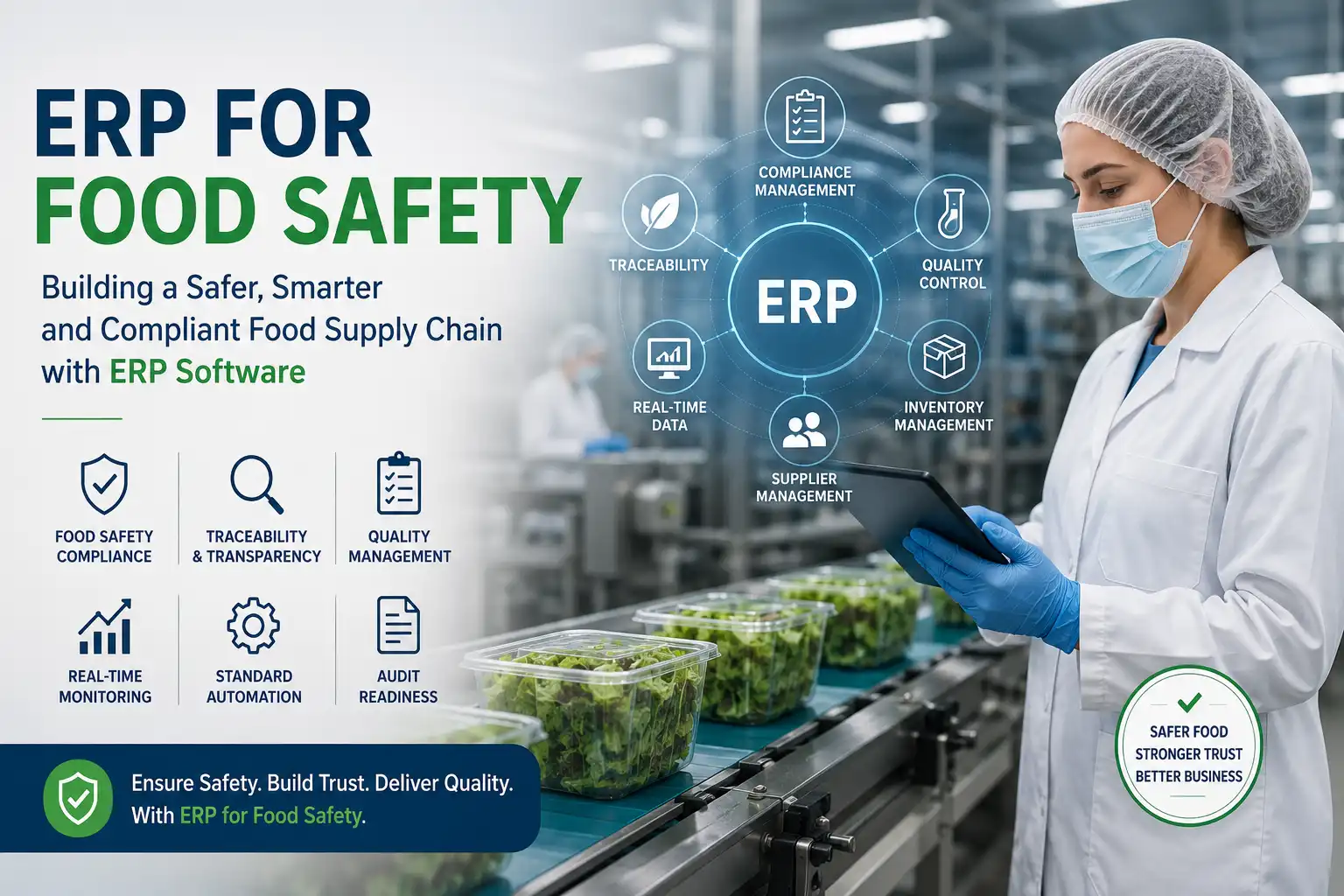
ERP for Food Safety: The Complete Guide to Food Safety, Traceability, Compliance, and Quality Management
Food safety is no longer only a responsibility of the quality-control department. For modern food and beverage manufacturers, it is a business-wide responsibility that affects production, procurement, inventory, warehousing, distribution, customer trust, regulatory compliance, and ultimately the company’s profitability.
Food businesses operate in an environment where a single contaminated raw material, incorrect label, expired ingredient, failed quality test, or poorly documented production batch can create serious consequences. The challenge becomes even greater as manufacturers expand their product portfolios, add suppliers, operate multiple warehouses, serve organized retail, and manage increasingly complex supply chains.
This is where ERP for food safety becomes important.
An ERP system designed or configured for food manufacturing can connect procurement, inventory, production, quality management, batch tracking, warehouse operations, traceability, finance, and compliance within one integrated environment. Instead of maintaining separate spreadsheets for batch numbers, paper-based quality records, manual expiry reports, and disconnected production data, businesses can create a connected digital record of how products move through the organization.
Modern food manufacturing ERP solutions commonly support capabilities such as recipe and formulation management, lot traceability, shelf-life monitoring, quality checkpoints, allergen management, production planning, inventory management, and compliance documentation.
For Indian food manufacturers, this becomes particularly relevant because food businesses must manage operational requirements alongside regulatory expectations such as FSSAI requirements and internationally recognized food-safety frameworks such as HACCP and ISO 22000.
This guide explains how ERP software for food safety can help food manufacturers build stronger processes, improve traceability, reduce waste, and prepare for audits and recalls.
What Is ERP for Food Safety?
ERP for food safety refers to an enterprise resource planning system that connects food manufacturing operations with the information required to maintain product quality, traceability, safety, and compliance.
Traditional ERP systems generally focus on areas such as:
- Finance
- Accounting
- Purchasing
- Sales
- Inventory
- Production
- Human resources
However, food manufacturers have additional requirements.
A food manufacturing operation may need to know:
- Which supplier supplied a particular ingredient?
- What was the supplier lot number?
- When was the ingredient received?
- What quality tests were performed?
- Was the ingredient approved before production?
- Which production batch used that ingredient?
- What recipe or formulation was used?
- Which finished-product batches were created?
- What was their expiry date?
- Which warehouse stored the products?
- Which distributors or customers received them?
- Were any quality deviations recorded?
- What should happen if a product needs to be recalled?
A specialized ERP software for food safety helps connect these pieces of information.
Instead of treating quality, production, inventory, and compliance as separate activities, ERP creates a common operational database.
That means a business can move from:
Supplier → Raw Material → Quality Check → Production → Finished Batch → Warehouse → Distribution → Customer
while maintaining an electronic record of the important information at each stage.
This connected approach is particularly valuable for food businesses because traceability is not simply an inventory requirement. It is an essential part of responding to quality incidents, complaints, recalls, and regulatory inspections.
Why Food Manufacturers Need ERP Software for Food Safety
Food manufacturing is fundamentally different from many discrete manufacturing environments.
A manufacturer producing mechanical components may primarily focus on specifications, part numbers, assembly sequences, and machine capacity.
A food manufacturer must deal with:
- Perishable ingredients
- Recipes
- Formulations
- Variable yields
- Batch production
- Expiry dates
- Allergens
- Quality testing
- Food contamination risks
- Packaging
- Nutritional information
- Lot numbers
- Recalls
- Regulatory documentation
- Temperature-sensitive inventory
- Waste and spoilage
The complexity increases when manufacturers operate multiple production lines, warehouses, suppliers, product categories, or distribution channels.
Industry-specific ERP systems are therefore increasingly designed around food manufacturing requirements such as formulation, batch processing, lot traceability, shelf-life management, allergen management, and compliance.
Without an integrated system, organizations often depend on a combination of:
- Excel spreadsheets
- Paper records
- WhatsApp messages
- Separate accounting software
- Standalone inventory systems
- Manual production registers
- Laboratory records
- Individual departmental databases
The problem is not that these tools cannot store information.
The problem is that they may not provide a single connected view of the product lifecycle.
For example, a quality manager may know that a particular ingredient failed a test, while the production team may not immediately know that the ingredient was used in a specific batch.
An ERP system can connect these processes so that information moves across departments as part of the workflow.
1. Batch Traceability: The Foundation of Food Safety
One of the most important capabilities of an ERP for food safety is batch and lot traceability.
Food manufacturers need to know where materials came from and where finished products went.
This creates two important forms of traceability:
Backward Traceability
Backward traceability answers:
Where did this product or ingredient come from?
For example:
Finished Product Batch F10025
↓
Production Order
↓
Ingredient Lot A450
↓
Supplier ABC Foods
↓
Supplier Delivery
This allows a company to investigate the source of a quality issue.
Forward Traceability
Forward traceability answers:
Where did this ingredient or finished product go?
For example:
Ingredient Lot A450
↓
Production Batch F10025
↓
Warehouse WH01
↓
Distributor A
↓
Retail Locations
If an ingredient is later identified as problematic, the business can determine which finished batches may be affected.
This is significantly more useful than simply knowing that “500 kg of the ingredient was purchased.”
The real value is knowing where that 500 kg went.
Modern food ERP systems commonly connect raw-material lots with finished-product batches and distribution records to support this type of traceability.
2. Faster and More Controlled Product Recalls
A product recall can become extremely complicated when a manufacturer cannot quickly determine which products are affected.
Imagine a food company discovers that a particular raw-material lot may have been contaminated.
Without effective traceability, the company may have to:
- Search purchase records
- Contact procurement
- Check production registers
- Search spreadsheets
- Contact warehouse teams
- Check dispatch documents
- Identify distributors
- Manually compare batch numbers
This can take hours or even days.
An ERP software for food safety can make the process significantly more structured.
The company can identify:
Supplier Lot → Production Batch → Finished Product → Warehouse → Dispatch → Customer
The organization can then determine which products need to be isolated or recalled.
This can help reduce unnecessary recalls.
Instead of recalling every product manufactured during a broad time period, the company may be able to identify the specific batches affected by the issue.
Traceability therefore has two benefits:
- It supports consumer safety.
- It can reduce the financial and operational impact of recalls.
3. Quality Management Integrated With Production
Quality management should not happen only after production is complete.
Food safety controls often need to be incorporated into multiple stages of the process.
For example:
Incoming Material Inspection
When raw materials arrive, quality teams may need to verify:
- Supplier
- Lot number
- Quantity
- Appearance
- Temperature
- Moisture
- Microbiological parameters
- Certificate of analysis
- Expiry or best-before date
- Other product-specific specifications
The material may then be:
Approved → Released for production
or:
Rejected → Quarantined
An ERP can help make these statuses visible to relevant teams.
4. Quality Checkpoints During Manufacturing
Quality control should not be limited to incoming materials.
Depending on the product and manufacturing process, organizations may require quality checks during production.
Examples include:
- Weight
- Temperature
- Moisture
- pH
- Colour
- Texture
- Microbiological parameters
- Packaging integrity
- Product specifications
An ERP can help define quality checkpoints within the manufacturing workflow.
This means quality becomes part of production rather than an isolated activity.
For example:
Production Start
↓
Process Quality Check
↓
Intermediate Inspection
↓
Finished Product Inspection
↓
Batch Approval
↓
Dispatch
Such workflows can create a more consistent operational process and provide an audit trail.
5. Recipe and Formulation Management
Food manufacturers rarely produce products using simple bills of materials alone.
Recipes and formulations can change based on:
- Ingredient availability
- Ingredient prices
- Product variants
- Batch sizes
- Regulatory requirements
- Customer specifications
- Nutritional requirements
- Quality improvements
A food-focused ERP should therefore support formulation management.
For example, a company manufacturing biscuits may have:
- Flour
- Sugar
- Vegetable fat
- Milk powder
- Cocoa
- Salt
- Flavouring
- Leavening agents
A formulation system can maintain the quantities and specifications associated with the product.
If the production quantity changes, the system can support batch scaling.
For example:
100 kg formulation
can be scaled to:
500 kg production
while maintaining the appropriate ingredient proportions.
Recipe and formulation management is a common requirement in food manufacturing ERP systems because food production is based on formulas and controlled processes rather than conventional discrete assembly alone.
6. Control Over Ingredient Changes
Ingredient substitution can create significant quality and safety concerns.
For example, a manufacturer may want to replace one supplier’s ingredient with another supplier’s equivalent ingredient.
Even if the ingredient appears similar, the organization may need to consider:
- Specification differences
- Allergen information
- Quality certificates
- Nutritional differences
- Regulatory requirements
- Supplier approval
- Product performance
An ERP system can help maintain controlled formulations and approval workflows.
Instead of allowing uncontrolled changes, organizations can establish:
Proposed Formula → Review → Approval → Effective Date → Production
This creates greater control over formulation changes.
7. Shelf-Life and Expiry Management
Food businesses deal with one major challenge that many industries do not face to the same extent:
Products can become unsafe or commercially unusable simply because too much time has passed.
An inventory system therefore needs more than quantity tracking.
It should also understand:
- Manufacturing date
- Expiry date
- Best-before date
- Shelf life
- Lot number
- Storage location
- Available quantity
- Reserved quantity
An ERP for food safety can provide visibility into ageing inventory and help teams identify products approaching their use-by or best-before dates.
This can prevent situations where expired inventory remains unnoticed in a warehouse.
8. FEFO: First Expiry, First Out
Traditional inventory management often uses FIFO:
First In, First Out
But food businesses frequently need another approach:
FEFO — First Expiry, First Out.
Under FEFO, inventory with the earliest expiry is prioritized for use or dispatch.
Consider:
| Batch | Quantity | Expiry |
|---|---|---|
| Batch A | 500 kg | September |
| Batch B | 700 kg | October |
| Batch C | 400 kg | December |
Even if Batch C arrived first, Batch A may need to be prioritized because its expiry is closer.
ERP can support this logic by providing inventory visibility based on expiry dates.
This helps reduce:
- Expired inventory
- Product disposal
- Warehouse losses
- Unnecessary write-offs
- Food safety risks
FEFO-based inventory management and expiry alerts are increasingly recognized as important capabilities for food manufacturing ERP.
9. Allergen Management
Allergen management is another important area for food manufacturers.
Depending on the product category and market, manufacturers may need to identify allergens associated with ingredients and finished products.
Potential allergen-related ingredients may include:
- Milk
- Soy
- Wheat/gluten
- Peanuts
- Tree nuts
- Eggs
- Fish
- Crustaceans
The exact regulatory requirements depend on the jurisdiction and product.
An ERP system can help maintain ingredient-level information and associate it with formulations and finished products.
This can help teams identify where particular allergens are present.
For manufacturers with many products and formulations, managing this information manually can become increasingly difficult.
10. Supplier Quality Management
Food safety begins before the raw material reaches the factory.
A manufacturer may work with dozens or hundreds of suppliers.
Each supplier can provide materials with different:
- Specifications
- Lot numbers
- Certificates
- Quality levels
- Delivery schedules
- Shelf lives
- Pricing
ERP can connect procurement and quality management.
For example:
Purchase Order
↓
Material Receipt
↓
Lot Creation
↓
Quality Inspection
↓
Approved / Rejected
↓
Inventory Release
This creates greater visibility over incoming materials.
A supplier quality issue can also be analyzed using historical information.
For example:
- Which supplier provided the material?
- Which lot failed?
- How many deliveries were affected?
- Which products used the material?
- What was the rejection rate?
This data can support supplier evaluation and corrective action.
11. Food Safety and Warehouse Management
Food safety does not stop when production finishes.
Warehouse conditions can affect product quality.
Businesses may need to manage:
- Storage locations
- Temperature requirements
- Batch numbers
- Expiry dates
- Stock rotation
- Quarantine inventory
- Rejected products
- Released products
- Damaged inventory
An ERP system can provide a centralized view of warehouse inventory.
Instead of asking:
“Where is Batch 1045?”
the warehouse team can search the ERP and identify the relevant inventory location.
Similarly, a quality team can determine which stock is:
Available
Quarantined
Rejected
or
Released
This reduces the risk of accidentally dispatching blocked or rejected inventory.
12. Managing Quarantine Inventory
When a raw material or finished product fails a quality check, it should not automatically become available stock.
A controlled quarantine process can help prevent accidental usage or dispatch.
A typical workflow might look like:
Material Received
↓
Quality Inspection
↓
Failed Test
↓
Quarantine
↓
Investigation
↓
Approved / Rejected / Reworked / Disposed
ERP can help maintain the status of the material throughout this process.
This is important because a product that is physically sitting in the warehouse may appear available unless the system clearly identifies its quality status.
13. ERP and Food Safety Compliance
Food manufacturers operate under regulatory and certification requirements that can vary according to country, product, facility, and market.
In India, FSSAI is a central part of the food regulatory environment.
Internationally, manufacturers may also work with frameworks and certifications such as:
- HACCP
- ISO 22000
- GMP
- FDA requirements for applicable markets
- Customer-specific food-safety standards
An ERP does not automatically make a business compliant.
This distinction is important.
ERP is a technology platform that can support compliance processes.
The organization still needs appropriate:
- Policies
- Procedures
- Training
- Quality controls
- Testing
- Documentation
- Corrective actions
- Management oversight
The ERP helps make these processes easier to document, control, retrieve, and audit.
14. Audit Readiness
Food businesses may need to provide documentation during internal audits, customer audits, certification audits, or regulatory inspections.
When records are spread across:
- Files
- Excel sheets
- Emails
- Paper registers
- Shared drives
collecting evidence can become a major administrative task.
An integrated ERP can make relevant operational information easier to retrieve.
For example, a business may need to demonstrate:
- Supplier information
- Raw material lot details
- Quality results
- Production batch records
- Formula versions
- Finished-product testing
- Inventory movements
- Dispatch records
- Corrective actions
Instead of manually assembling information from different systems, teams can retrieve connected records.
Industry-specific ERP solutions are designed to provide structured digital records around traceability, quality, and compliance workflows.
15. Corrective and Preventive Actions
When a quality problem occurs, identifying the problem is only the beginning.
The organization may need to determine:
What happened?
Why did it happen?
What should be corrected?
How can it be prevented from happening again?
This is where CAPA — Corrective and Preventive Action — becomes important.
For example:
Problem
Finished batch fails quality testing.
Investigation
Possible causes:
- Raw material issue
- Production parameter deviation
- Equipment problem
- Operator error
- Storage issue
Corrective Action
Hold affected inventory and investigate the production batch.
Preventive Action
Modify the relevant process control or supplier requirement.
ERP-supported quality workflows can help maintain records of deviations, investigations, corrective actions, approvals, and outcomes.
16. Managing Food Waste With ERP
Food waste is both a financial and operational issue.
Waste can occur because of:
- Expired raw materials
- Overstocking
- Production losses
- Incorrect formulations
- Quality rejection
- Damaged packaging
- Poor forecasting
- Warehouse problems
- Product returns
ERP can help manufacturers identify where waste is occurring.
For example, production data can show:
Planned Input: 1,000 kg
Actual Input: 1,000 kg
Expected Output: 900 kg
Actual Output: 830 kg
The difference becomes an investigation point.
The company can then determine whether the problem came from:
- Process loss
- Raw material variation
- Machine performance
- Operator practices
- Quality rejection
This turns waste management from guesswork into data-driven analysis.
17. Production Planning and Food Safety
Production planning also affects food safety.
Poor planning can create:
- Excess inventory
- Expired ingredients
- Unnecessary product changeovers
- Increased storage time
- Production bottlenecks
- Emergency purchasing
- Higher waste
An integrated ERP can connect:
Demand → Inventory → Procurement → Production → Quality → Warehouse → Distribution
This allows manufacturers to make better production decisions.
For example, if an ingredient has a short shelf life, production planning can consider available inventory before purchasing additional quantities.
18. Managing Multiple Product Variants
Modern food companies often produce many variations of similar products.
For example:
- 100 g pack
- 250 g pack
- 500 g pack
- 1 kg pack
The underlying product may be similar, but packaging, labeling, pricing, and production requirements can differ.
ERP helps maintain structured product and packaging information.
This becomes especially valuable as product portfolios grow.
Without a centralized system, teams may accidentally use outdated product information or incorrect packaging specifications.
19. Packaging and Label Control
Packaging is an important part of food safety and regulatory compliance.
A food product may require correct information relating to:
- Product name
- Ingredients
- Allergen declarations
- Net quantity
- Dates
- Batch number
- Manufacturer details
- Storage instructions
- Nutritional information
- Regulatory information
An ERP can help connect product and batch information with packaging processes.
For example, a finished batch can be associated with a particular production run and packaging configuration.
This creates greater control over which packaging materials are used with which product.
20. Managing Product Returns
Food businesses may receive returns because of:
- Damaged packaging
- Customer complaints
- Incorrect deliveries
- Quality concerns
- Expiry issues
- Distribution problems
Returned goods should not simply be added back into normal inventory.
They may require:
Return → Inspection → Quarantine → Decision → Disposal / Rework / Release
ERP can help maintain this workflow.
This creates visibility into returned products and prevents potentially unsuitable stock from being mixed with released inventory.
21. Customer Complaints and Traceability
Customer complaints can provide valuable information about product quality.
Suppose a customer reports:
“The product has an unusual smell.”
The quality team may need to determine:
- Product batch
- Manufacturing date
- Raw materials
- Supplier
- Production line
- Other complaints from the same batch
- Distribution locations
If the organization has integrated ERP data, investigation can be much faster.
A complaint can be connected to the relevant batch.
The quality team can then analyze whether similar complaints were reported against:
- The same batch
- The same ingredient
- The same supplier
- The same production line
This helps identify recurring quality problems.
22. ERP for Food Safety and Real-Time Visibility
One of the biggest advantages of ERP is visibility.
Management does not need to wait until the end of the month to understand what happened.
They can monitor relevant operational information such as:
- Inventory
- Production
- Quality failures
- Batch status
- Expiring stock
- Supplier performance
- Waste
- Production yield
- Sales
- Dispatch
- Returns
This can improve decision-making.
For example, a plant manager may see that a particular raw material has unusually high rejection rates.
Instead of discovering this during a monthly review, the organization can investigate earlier.
23. Connecting Quality, Inventory, Production, and Finance
One of the biggest weaknesses of disconnected systems is that every department sees only part of the picture.
Consider a quality issue involving an expensive ingredient.
The quality team sees:
Rejected Ingredient
The warehouse sees:
Blocked Stock
Production sees:
Material Unavailable
Procurement sees:
Supplier Issue
Finance sees:
Inventory Loss
An integrated ERP connects these perspectives.
This allows management to understand the entire business impact of the issue.
That is one reason ERP should not be viewed merely as accounting software.
It is a platform for connecting business processes.
24. What Should You Look for in ERP Software for Food Safety?
Not every ERP system is equally suitable for food manufacturing.
When evaluating ERP software for food safety, businesses should consider the following capabilities.
1. Lot and Batch Traceability
The system should allow businesses to trace raw materials and finished products.
2. Recipe and Formulation Management
The ERP should support formulas, versions, quantities, and controlled changes.
3. Shelf-Life Management
The system should track expiry and shelf-life information.
4. FEFO Support
Inventory should be manageable based on expiry priority.
5. Quality Management
The system should support quality inspections and test results.
6. Quarantine Management
Rejected or pending materials should be clearly separated from released inventory.
7. Supplier Quality
Supplier lots, certificates, inspections, and rejection history should be trackable.
8. Recall Management
The ERP should allow organizations to identify affected batches and destinations.
9. Allergen Management
Ingredient and product information should support allergen controls.
10. Compliance Documentation
The system should make relevant operational records accessible for audits and reviews.
11. Production Management
Manufacturing processes, batches, yields, and production orders should be connected.
12. Warehouse Management
Inventory should be visible by batch, location, status, and expiry.
13. Reporting and Analytics
Management should be able to identify trends in quality, waste, production, and inventory.
14. Scalability
The system should support growth in products, facilities, users, suppliers, and customers.
25. ERP for Food Safety vs. Generic ERP
A generic ERP may provide basic:
- Inventory
- Purchasing
- Sales
- Finance
- Manufacturing
But food manufacturers often require more specialized functionality.
| Requirement | Generic ERP | Food-focused ERP |
|---|---|---|
| Financial management | Yes | Yes |
| Inventory | Yes | Yes |
| Purchasing | Yes | Yes |
| Production | Usually | Yes |
| Batch tracking | May require configuration | Core capability |
| Recipe management | Limited in some systems | Strong |
| Shelf-life management | May require customization | Core capability |
| FEFO | May require configuration | Supported |
| Quality management | Varies | Strong |
| Allergen management | Limited | Supported in specialized systems |
| Recall traceability | Varies | Core requirement |
| Food compliance workflows | Often customized | Better aligned |
| Supplier quality | Varies | Integrated |
The important point is not that every food business needs a completely different ERP.
Rather, the ERP must be capable of supporting the processes that make food manufacturing different.
26. How ERP Can Support FSSAI-Oriented Operations
For Indian food businesses, FSSAI requirements are an important consideration.
An ERP cannot replace regulatory compliance, but it can support the processes used to demonstrate control.
For example, an organization can use ERP workflows to maintain information associated with:
- Raw material suppliers
- Product batches
- Quality inspections
- Production records
- Inventory
- Expiry
- Dispatch
- Returns
- Rejected stock
- Traceability
This can make documentation more structured.
For businesses operating across multiple facilities or distribution locations, centralized information can also make it easier to maintain consistent processes.
27. HACCP and ERP
HACCP — Hazard Analysis and Critical Control Points — is widely used as a systematic approach to food safety.
The methodology focuses on identifying and controlling hazards throughout the food production process.
ERP can support HACCP-related operational processes by connecting:
Process → Control Point → Measurement → Result → Deviation → Corrective Action
For example:
A critical process parameter may need to remain within a defined range.
If a measurement falls outside the accepted range, the organization can record the deviation and initiate the appropriate workflow.
The ERP therefore becomes a system for documenting operational activity around food safety controls.
28. Data Accuracy Matters as Much as Automation
Installing an ERP does not automatically solve food safety problems.
The quality of the output depends on the quality of the data entered into the system.
For example, if employees enter:
- Wrong batch numbers
- Incorrect expiry dates
- Incorrect quantities
- Wrong supplier lots
- Incorrect quality results
then the ERP’s traceability information will also be unreliable.
Therefore, implementation should include:
- User training
- Barcode or scanning processes where appropriate
- Standardized master data
- Approval workflows
- Access controls
- Data validation
- Regular audits
Technology should support good processes, not replace them.
29. Barcodes and ERP Traceability
Barcode scanning can further improve traceability.
Instead of manually entering every lot number, employees can scan relevant identifiers during:
- Receiving
- Put-away
- Production
- Warehouse movement
- Picking
- Dispatch
This can reduce manual data-entry errors.
For high-volume operations, barcode integration can make batch-level tracking significantly more practical.
30. Cloud ERP for Food Safety
Cloud ERP is increasingly attractive to food businesses because employees may need access to operational information across different locations.
A cloud ERP can potentially connect:
- Manufacturing plants
- Warehouses
- Offices
- Distribution centers
- Sales teams
- Management
For businesses operating multiple sites, this can create a centralized view of inventory, production, and quality.
However, organizations should still evaluate:
- Security
- User permissions
- Data backup
- Integration
- Internet dependency
- Vendor support
- Compliance requirements
- Total cost of ownership
Cloud should be selected based on business requirements rather than simply because it is a popular technology model.
31. ERP Analytics for Food Safety
ERP data can also become a valuable source of business intelligence.
Organizations can track indicators such as:
Quality KPIs
- Batch rejection rate
- Supplier rejection rate
- Customer complaints
- Quality deviations
- Rework percentage
Inventory KPIs
- Expired stock
- Near-expiry stock
- Inventory turnover
- Slow-moving inventory
- Stock losses
Production KPIs
- Yield
- Production efficiency
- Downtime
- Scrap
- Batch variance
Supplier KPIs
- On-time delivery
- Quality rejection
- Certificate compliance
- Material consistency
Management can use these metrics to identify areas where food safety and operational performance can improve simultaneously.
32. The Business Cost of Poor Traceability
Poor traceability creates more than a compliance problem.
It can affect:
Financial Performance
Product losses, recalls, wastage, and operational disruption can increase costs.
Brand Reputation
Consumers and retailers expect consistent quality and safety.
Customer Relationships
Large retailers and distributors may require suppliers to demonstrate strong quality and traceability systems.
Operational Continuity
A serious compliance issue can disrupt production or distribution.
Management Time
Employees may spend hours manually searching for information.
Decision-Making
Management cannot respond quickly when critical information is fragmented.
ERP can help address these problems by creating a connected information system.
33. How ERP Changes a Typical Food Manufacturing Workflow
Consider a simplified example.
Before ERP
Supplier sends material.
↓
Warehouse records receipt in Excel.
↓
Quality team performs inspection on paper.
↓
Production receives information through email.
↓
Production records batch information separately.
↓
Warehouse records finished goods in another spreadsheet.
↓
Dispatch maintains its own records.
↓
Customer complaint arrives.
↓
Quality team searches multiple files.
This process can create delays and errors.
With Integrated ERP
Supplier Purchase Order
↓
Material Receipt
↓
Lot Creation
↓
Quality Inspection
↓
Approved / Quarantined / Rejected
↓
Production Order
↓
Recipe + Ingredient Lots
↓
Finished Batch
↓
Quality Approval
↓
Warehouse
↓
FEFO-Based Dispatch
↓
Customer / Distributor
↓
Traceability Record
If a complaint occurs, the business can use the same system to investigate the batch.
This is the practical meaning of ERP for food safety.
34. How to Implement ERP for Food Safety
Implementation should not begin with software configuration alone.
A successful project starts with understanding the existing business processes.
Step 1: Map Current Processes
Document:
- Procurement
- Receiving
- Quality
- Production
- Warehouse
- Dispatch
- Returns
- Complaints
- Recall
Step 2: Identify Food Safety Risks
Determine where the organization currently has:
- Manual records
- Traceability gaps
- Expiry risks
- Quality bottlenecks
- Data duplication
- Compliance documentation problems
Step 3: Define ERP Requirements
Create a list of required capabilities.
Step 4: Clean Master Data
Review:
- Products
- Ingredients
- Suppliers
- Customers
- Units
- Recipes
- Warehouses
- Quality parameters
Step 5: Configure Workflows
Create processes for:
- Quality inspection
- Quarantine
- Release
- Batch creation
- Recall
- Expiry
- CAPA
Step 6: Train Employees
Users need to understand not only how to operate the ERP but why accurate data matters.
Step 7: Test Traceability
Conduct simulated scenarios.
For example:
“Find every finished batch that used Raw Material Lot X.”
If the system cannot answer this quickly, the traceability process needs improvement.
Step 8: Monitor KPIs
After implementation, measure:
- Waste
- Quality failures
- Traceability time
- Inventory accuracy
- Expiry losses
- Supplier rejection
- Production yield
35. Questions to Ask an ERP Vendor
Before selecting ERP software for food safety, food manufacturers should ask vendors practical questions.
Traceability
- Can the system perform forward and backward traceability?
- Can raw-material lots be connected to finished batches?
- Can finished batches be traced to customers?
Quality
- Can quality checkpoints be configured?
- Can test results be recorded?
- Can failed materials be quarantined automatically?
Shelf Life
- Can expiry dates be tracked by lot?
- Does the system support FEFO?
- Can near-expiry alerts be configured?
Production
- Does it support batch manufacturing?
- Can recipes be version-controlled?
- Can actual ingredient consumption be compared with standard formulation?
Compliance
- Can audit records be retrieved quickly?
- Can the system support FSSAI-related operational documentation?
- Can it support HACCP and ISO 22000-related workflows?
Recall
- How quickly can an affected batch be identified?
- Can the system identify all customers who received the batch?
Integration
- Can it integrate with barcode scanners?
- Can it connect with laboratory or quality systems?
- Can it integrate with accounting and other business applications?
These questions can help organizations evaluate an ERP based on real operational requirements rather than a long list of generic features.
36. Who Should Consider ERP for Food Safety?
An ERP-based approach can be particularly useful for:
- Food manufacturers
- Beverage manufacturers
- Dairy companies
- Bakery manufacturers
- Packaged food companies
- Spice manufacturers
- Edible oil manufacturers
- Snack manufacturers
- Ready-to-eat food producers
- Food ingredient manufacturers
- Food distributors
- Cold-chain operators
- Multi-location food businesses
The need becomes stronger as a company grows.
A small operation may be able to manage basic records manually.
But when the business has:
Hundreds of SKUs + Multiple suppliers + Multiple warehouses + Batch production + Expiry-sensitive inventory + Large distribution network
manual processes become much harder to control.
37. What the Future of Food Safety Management Looks Like
The future of food safety management is moving toward greater digitalization.
ERP systems are increasingly becoming connected with:
- IoT sensors
- Barcode systems
- Warehouse automation
- Laboratory systems
- Business intelligence
- Artificial intelligence
- Predictive analytics
For example, temperature-sensitive products may be monitored through connected sensors.
ERP can potentially combine operational data with sensor information to help identify risks earlier.
AI can also help analyze patterns such as:
- Increasing supplier rejection
- Abnormal production yields
- Repeated quality failures
- Unusual waste
- Expiry risk
- Demand fluctuations
This means ERP may evolve from a system that records what happened into a platform that helps businesses identify what may happen next.
38. ERP Is Not Just an IT Investment
It is easy to think of ERP as a software purchase.
For food manufacturers, it is more useful to think of ERP as an operational control system.
The objective is not simply:
“Install ERP.”
The objective is:
Improve visibility → Strengthen control → Improve traceability → Reduce risk → Improve efficiency.
A successful implementation connects people, processes, data, and technology.
39. Why Food Safety and Business Efficiency Should Be Managed Together
Food safety and profitability are sometimes treated as separate goals.
They should not be.
Many improvements that strengthen food safety can also improve business performance.
For example:
Better Traceability
Can reduce the time required for investigations.
Better Expiry Management
Can reduce waste.
Better Supplier Quality
Can reduce rejected materials.
Better Production Control
Can improve yield.
Better Inventory Visibility
Can reduce overstocking.
Better Quality Management
Can reduce customer complaints.
Better Recall Management
Can reduce the scale of unnecessary product withdrawals.
This is why ERP software for food safety should be viewed as both a compliance-support tool and a business management platform.
40. Final Checklist for Choosing ERP for Food Safety
Before selecting a solution, food manufacturers should evaluate whether the ERP can support:
- Raw-material lot tracking
- Finished-product batch tracking
- Forward traceability
- Backward traceability
- Recipe management
- Formula version control
- Shelf-life tracking
- Expiry alerts
- FEFO inventory management
- Quality inspections
- Quarantine management
- Supplier quality management
- Allergen information
- Production batch management
- Yield and waste tracking
- Product returns
- Recall management
- CAPA workflows
- Audit documentation
- FSSAI-oriented operational records
- HACCP-related controls
- ISO 22000-related documentation
- Warehouse management
- Barcode integration
- Reporting and analytics
- Multi-location support
- Role-based access
- Cloud or on-premise deployment options
- Integration with existing business systems
Conclusion: Building a More Traceable and Safer Food Business With ERP
Food safety is becoming increasingly connected to operational visibility.
A food manufacturer cannot effectively manage safety if it cannot determine where its ingredients came from, which batches they entered, where finished products were stored, or where those products were ultimately distributed.
This is why ERP for food safety is becoming an important part of modern food manufacturing.
The right ERP can connect:
Procurement
→ Raw Material
→ Quality
→ Production
→ Batch
→ Inventory
→ Warehouse
→ Distribution
→ Customer
At the same time, it can provide the information required for better expiry management, quality control, traceability, waste reduction, supplier evaluation, and audit preparation.
Food-focused ERP solutions increasingly combine formulation management, batch traceability, shelf-life control, quality management, inventory, and compliance-related processes in a single platform.
The most important question for a food manufacturer is therefore not simply:
“Do we have an ERP?”
The better question is:
“Can our ERP tell us exactly what happened to every important ingredient and product throughout its lifecycle?”
If the answer is no, there may be a significant opportunity to improve traceability, quality, and operational control.
For growing food manufacturers, investing in the right ERP software for food safety can help transform food safety from a collection of disconnected records into a continuous, data-driven business process.
The goal is not to wait for an audit, complaint, or recall to discover a traceability gap.
The goal is to have the information available before the question is asked.
Frequently Asked Questions About ERP for Food Safety
1. What is ERP for food safety?
ERP for food safety is an enterprise resource planning solution that integrates food manufacturing processes such as production, inventory, quality management, batch traceability, shelf-life management, formulation, warehouse operations, and compliance-related documentation.
2. How does ERP improve food safety?
ERP can improve food safety by connecting raw-material lots, quality inspections, production batches, inventory, expiry information, and distribution records. This makes it easier to identify problems and investigate affected products.
3. What is the most important ERP feature for food safety?
Batch and lot traceability is one of the most important capabilities. A business should be able to trace raw materials into finished products and finished batches to their distribution destinations.
4. Can ERP help with food recalls?
Yes. An ERP with strong traceability can help identify affected batches, raw-material sources, inventory locations, and customers or distributors that received specific products.
5. Does ERP help manage expiry dates?
Yes. Food-focused ERP systems can track manufacturing dates, expiry dates, shelf life, and batch information. Some systems also support FEFO inventory management and expiry alerts.
6. Can ERP support FSSAI compliance?
ERP can support the operational processes and documentation associated with food safety management, including traceability, quality records, batch information, and inventory controls. However, ERP software itself does not guarantee regulatory compliance.
7. Can ERP support HACCP?
ERP can support HACCP-related workflows by recording quality checkpoints, process measurements, deviations, corrective actions, and associated production information.
8. Is a generic ERP suitable for food manufacturers?
It can be, depending on its functionality and configuration. However, food manufacturers should carefully evaluate whether the ERP supports formulation, batch traceability, shelf life, quality management, allergens, recalls, and other food-specific requirements.
9. Can ERP reduce food waste?
Yes. Better expiry management, FEFO, production-yield monitoring, inventory visibility, and quality control can help identify and reduce sources of food waste.
10. What should a food manufacturer look for in ERP software?
Key capabilities include batch traceability, recipe and formulation management, shelf-life tracking, quality management, quarantine controls, FEFO, supplier quality, recall management, production management, warehouse management, compliance documentation, and analytics.
11. Is ERP useful for small and medium food manufacturers?
Yes. The business case depends on operational complexity rather than company size alone. Manufacturers with multiple products, suppliers, batches, warehouses, or regulatory requirements can benefit from greater process integration.
12. Why is traceability important in food manufacturing?
Traceability allows businesses to identify where materials came from and where products went. This is essential when investigating complaints, quality problems, contamination risks, and product.